We had another early start today. Our ship is anchored just a short distance from the entrance to the Horizontal Falls in Talbot Bay, one of the Kimberley region’s most popular features. In small groups, we boarded zodiacs at the stern of our ship. We had company – tawny nurse sharks. At one time there were three of them swimming back and forth behind our boat. Two weren’t there for long and disappeared. The other hung around for a long time, well over an hour. The sharks are apparently harmless, and a couple of our crew members demonstrated that by reaching down and patting the shark on the back of its head. It didn’t flinch. I guess it has tourist boats in here all the time and is not at all fazed by the presence of humans.


There were a couple of other cruise ships anchored in Talbot Bay, also sending zodiacs and small craft through the falls. At around 8.30 am, about half a dozen seaplanes came in to land on the bay, one after another. I think they were bringing people up from Broome. When they landed on the water, the passengers were able to transfer from the plane to waiting craft for the complete Horizontal Falls highlight package.
We sent off two zodiacs at a time. Mel from our crew was in the third zodiac, waiting by the first gap in the falls as both a safety measure and photographer. We were asked not to bring large cameras and not to take any photos during our trip through the gap, as both hands were required to hang on tight to the ropes in our craft. Failure to do so could possibly have resulted in us going through the falls independently, struggling to keep our heads above the raging torrent as the zodiac continued on without us. That idea didn’t thrill me, so I didn’t even take my small camera. I just did what I was told and held on tight. Rod took his phone and grabbed a couple of shots before the passage through the gap, so I’m grateful that I’m able to use those. A couple of weeks after we return home, we’ll also get access to the shots Mel got of us going through the falls, along with all of Richard’s brilliant nature and landscape photos. I’m really looking forward to receiving that.
The falls are essentially two narrow gaps where water from the Kimberley’s massive tides (they vary by about ten metres here) surges between gorges, creating a turbulent rush of water that provides a thrilling ride for our zodiac groups. The first gap is about twenty metres across and the second one is about ten metres across. The second gap is considered too dangerous and craft are no longer permitted to attempt to go through it. The falls are created when a vast amount of water from the higher level is forced into a narrow gap faster than it can drain through to the other side, so it creates a water level difference of up to 1.5 metres from one side of the gap to the other.
The bay on either sides of the first gap is calm, so the passage through the falls does not last long, but it’s an exhilarating ride, and then you’re out the other end on flat water again, although at a different level to the water you’d come in on. There’s about 300 metres of flat water to travel across before you reach the second, narrower gap. We went over for a look at it, but, as I mentioned, could not pass through it.
We were in Craig’s zodiac. He’s a brilliant operator. We love his skilful handling of the tender, and we felt in safe hands with him in control of the Zodiac. But he’s also a thrillseeker, so he made sure we had an exhilarating ride. And once we’d got through safely to the other side, he took us back through the falls for another go. Brilliant!


This afternoon, the Xplorer took us out for a scenic cruise of the upper waterways of Talbot Creek. Talbot Creek is also known as Cyclone Creek. This name was given to it by the crews of the pearling boats that once operated in this region. When severe storms struck the coastline, the pearling fleets would retreat into the sheltered waters of this creek until the storm had passed.
The tide was rising when we entered the waters of the creek. With the exception of one passage through a rocky section where swirling whirlpools made navigation a little tricky, the water was calm and we sometimes cut the engine and just drifted slowly in order to have a longer look at some of the geological features.
Our resident geologist, Garry, pointed out that the sandstone cliffs along this creek differed significantly from those we had visited earlier in the trip. Whereas much of the sandstone we had sighted previously had been laid down in easily recognisable horizontal layers, the sandstone cliffs had layers running diagonally, and sometimes almost vertically. Garry said that this was some of the oldest stone in the whole Kimberley. During the formation of Gondwanaland over550,000 million years ago, the sandstone layers had been put under extreme pressure, causing them to fold. Under such pressure, sandstone layers, formerly horizontal, were forced into new orientations. The folding is clearly visible in the photos below.


Another geological feature that Garry pointed out was the conglomerates we came across in a couple of places. Conglomerate is formed from pebbles, small rocks and rounded stones which have been virtually cemented into the sandstone. The conglomerate here in Cyclone Creek was formed over a billion years ago when the rock and stone fragments were once part of a riverbed. The action of the flowing water wearing down the rocks and tumbling them along in the current contributed to the smoothing and rounding of the stones. When they settled in the sand and gravel at the bottom of the riverbed and the river dried up, the sediment hardened all around the stones and pebbles, forming the conglomerate.


We were told to keep our eyes open for wallabies, but unfortunately we didn’t see any. We didn’t see any birds either, although we could hear them twittering when the boat was silently drifting. I liked the vegetation we saw in several places along the creek. I like the mangroves, particularly when the tide is rising and some of the lower branches are submerged. I also like the spinifex grass that blanketed several of the hillsides. You can see spinifex in the first two photos below.
I spotted a few trees with stark white trunks. They stood out from all the other vegetation surrounding them because of the colours of their bark and their green leaves, both of which contrasted well with the colours of the sandstone. A Kimberley rose was pointed out to us. It didn’t have much foliage, but instead had beautiful red flowers.


Our tender returned along Cyclone Creek the way it had come in. Once we entered Talbot Bay, our driver brought us into the approach to the Horizontal Falls so we could have one last look at them. Obviously we couldn’t venture in as close as our zodiacs had, but we came in close enough that I could get a few photos through the gap to the flat water beyond. If you click on one or two of these to enlarge them, and look carefully, you will probably see how the water flowing into the gap drops from a higher level down to a lower level when it reaches the calm water on the other side. Of course, there are also times when the water level on the far side is higher and the torrent churns through the gap in the opposite direction.


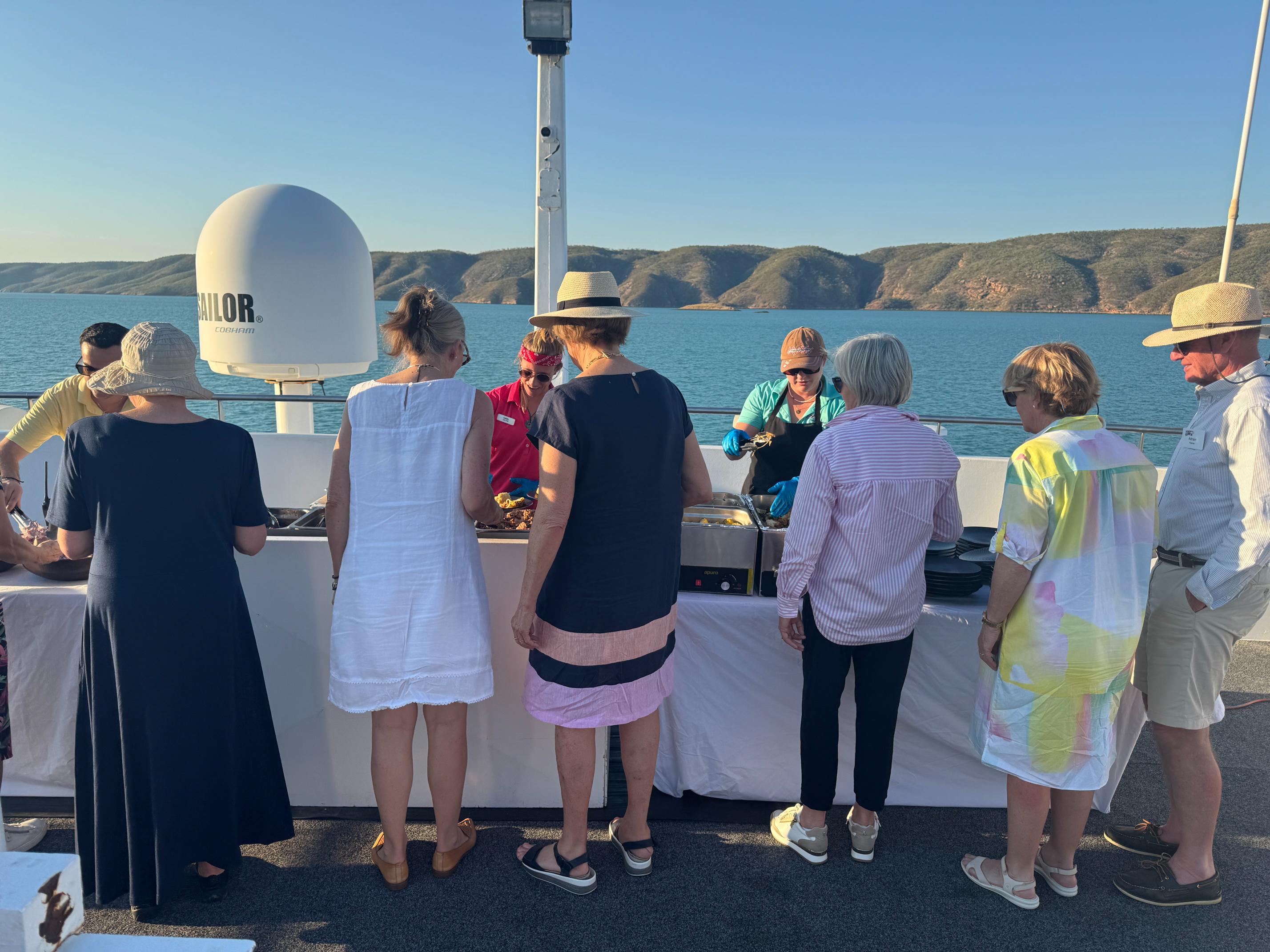
Tonight we were all invited to a barbecue on the upper deck. The food on this cruise has been amazing, and tonight was no exception. Tonight, the plump, tasty prawns were my favourite and I didn’t hesitate to go back for seconds. Marg, Cornelia, Rod and I shared a table with our new friends Deb and Rod from Echuca. It’s been a lot of fun sharing the voyage with them. We’ve shared some great experiences and had lots of laughs. Watching the sun go down over Talbot Bay tonight with great company, good food and a drink in hand was a fitting end to a really enjoyable day.




Amazing pics and views Garry. Sounds wonderful.
LikeLiked by 1 person
Thanks for following our travels, Janie. See you soon 🙂
LikeLike